Quick Answer: Handmade wallets use a traditional saddle-stitch technique where two independent needles lock every single stitch, making them virtually indestructible. Machine-made wallets use a mechanical lock-stitch that can completely unravel if a single thread breaks. Consequently, a handmade wallet will outlast a machine-made wallet by decades.
The Illusion of Mass Production
In 2026, the retail market is saturated with "luxury" designer wallets that command prices upwards of $500. Yet, behind the flashy logos, the vast majority of these wallets are assembled on factory lines using automated sewing machines and cheap edge paints.
When you compare a handmade wallet from a boutique artisan to a mass-produced designer wallet, the difference in structural integrity is night and day. Understanding how wallets are constructed will save you from spending hundreds of dollars on a product engineered to fail.
The Sewing Machine: The Lock-Stitch Flaw
Industrial sewing machines are built for speed, not permanence. They utilize a mechanism that creates a "lock stitch."
In a lock stitch, two threads (a top thread and a bobbin thread) meet in the middle of the leather and hook around each other.
- The Fatal Flaw: Because the threads simply loop around one another, they are entirely dependent on continuous tension. If you slide your wallet into your pocket and your keys accidentally cut one single loop of the thread, the entire seam will rapidly unravel. Within days, the layers of your wallet will separate.
The Artisan: The Saddle-Stitch Advantage
True handmade leather wallets do not touch a sewing machine. They are stitched by a human using an awl, waxed linen thread, and two needles. This is known as the "saddle stitch," originally developed for equestrian gear that needed to withstand extreme stress.
- The Indestructible Seam: In a saddle stitch, both needles pass entirely through the same hole from opposite directions. Every single stitch is an independent knot. If a thread is cut or breaks, the rest of the seam remains completely locked in place. It will never unravel.
Edge Treatment: Burnishing vs. Painting
The edge of the leather is another dead giveaway of a wallet's origin.
- Machine-Made (Edge Paint): Factories cut costs by slathering the raw edges of the leather with an acrylic or rubberized edge paint. It looks perfectly smooth on the shelf, but after a few months of bending in your pocket, this paint cracks and peels off like dead skin.
- Handmade (Burnishing): An artisan uses a wooden tool (a slicker) and natural beeswax to vigorously rub the raw edges by hand. The friction creates heat, melting the wax and the leather fibers together into a hard, glossy, natural seal that will never peel.
Top Handmade Leather Wallet Recommendations
At Leonadem, we refuse to compromise. Every wallet we produce is hand-stitched and hand-burnished for a lifetime of use.

Slim Handmade Leather Wallet for Men
Shop NowThe perfect entry into the world of bespoke craftsmanship. Saddle-stitched and perfectly sized for modern minimalist carry.
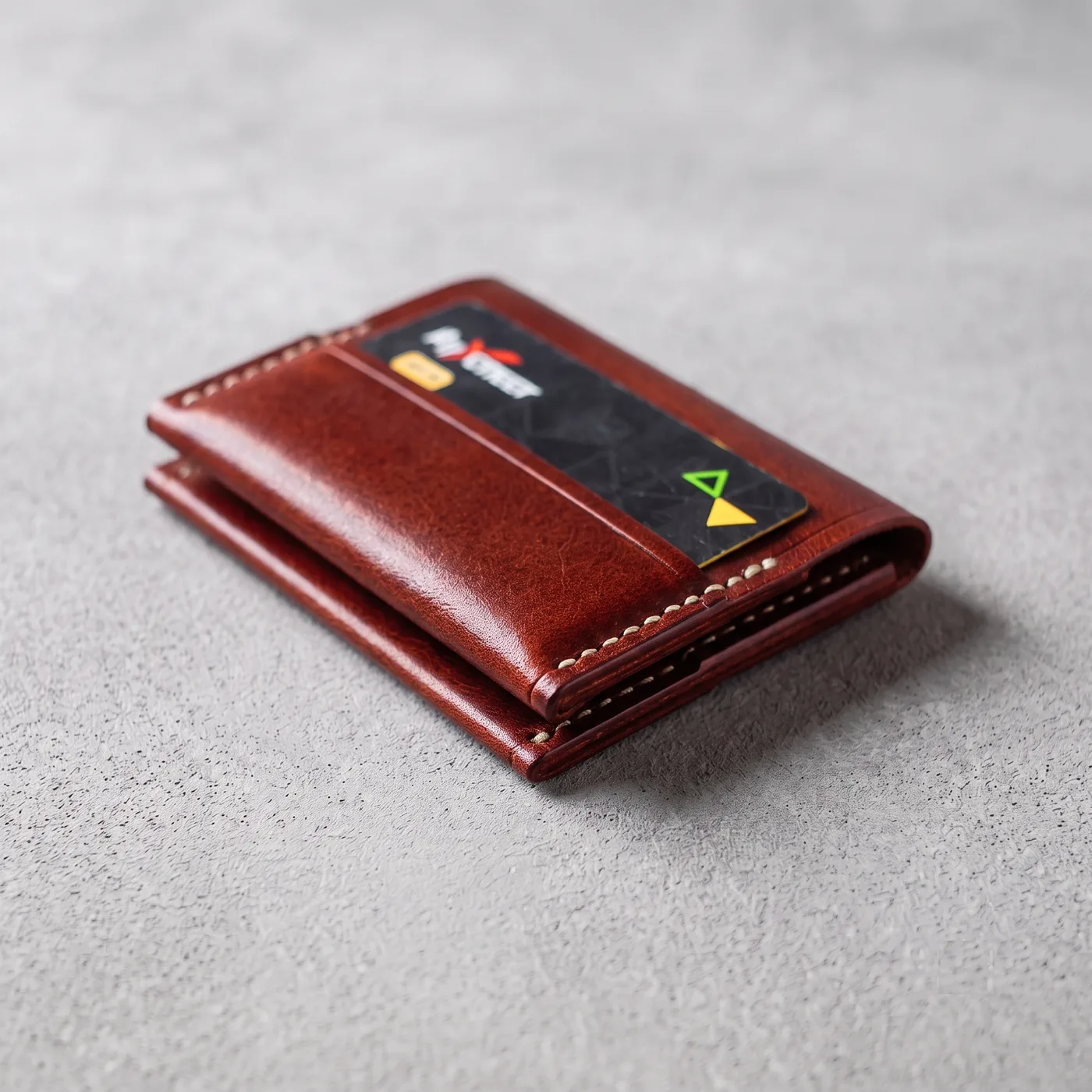
Custom Leather Wallet for Men
Shop NowExperience the peak of handmade quality. You choose the specifications, and our artisans stitch it by hand using premium full-grain leather.
FAQ
Why are machine-made wallets more common if handmade is better?
Machine-made wallets are vastly cheaper and faster to produce. A factory can sew hundreds of wallets an hour using a lock-stitch, whereas a single hand-stitched wallet can take an artisan several hours to complete.
Are designer wallets handmade?
The vast majority of modern designer wallets are machine-made. While they may use quality materials, they rely on mechanical lock-stitching and edge painting for mass-market scalability.